
Pentatonic Scales and the Native American Style Flute Explained
Understanding the Octave and the Chromatic Scale
An octave is a measurement of musical distance. An octave stretches from a note of a given frequency such as A at 440Hz up to the next A at twice that frequency, which is 880Hz. It can also be measured downward to an A at half the frequency, which is 220Hz.
An octave is divided into twelve notes of equal distance from each other. In musical terminology the distance between each note is called a half step. A half step is further divided into one hundred cents. A twelve note octave is also called a chromatic scale. On a piano, the octave consists of twelve successive keys.
Another way to think of an octave is as twelve musical steps on a spiral staircase. When you start on a note and climb twelve steps you reach the same note again, one octave higher. The thirteenth step places you directly above the first, repeating the pattern. The same is true when descending.
No matter which of the twelve notes you begin on, one full revolution of the spiral returns you to the same note name at a higher or lower frequency.
What Is a Pentatonic Scale
A pentatonic scale uses five of the twelve notes within the octave. A song written in a pentatonic scale is a composition 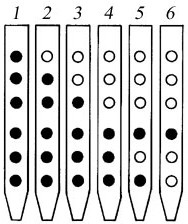 built from those five notes arranged in different sequences.
What makes a pentatonic scale so pleasing is that any of the five notes sound harmonious with the others. Simply experimenting with combinations of these notes produces beautiful sound. If you have ever played random notes on a piano keyboard you know that not all twelve notes blend well together. The same is true of a diatonic seven note scale.
Within a pentatonic scale the musician may move freely from top to bottom and skip between notes without producing harsh combinations. The structure of the scale allows intuitive music making.
Musicians sometimes touch on notes outside the pentatonic pattern. These are called grace notes. To use them effectively the flute must be properly tuned so that the hidden chromatic notes can be played through cross fingering or half holing.
The Five Pentatonic Modes
For a pentatonic scale to sound pleasing, the five notes must follow one of five specific patterns. Ancient musicians discovered these patterns by listening and intuiting what sounded right.
Using the staircase analogy, when a musician begins on step one, which is called the fundamental, he must climb the staircase stepping over intervals of either two or three steps. The pattern must follow certain rules. The three step intervals cannot be adjacent to each other.
Let us use the chromatic scale beginning on A. The twelve notes from A to the next higher A are:
A, A sharp or B flat, B, C, C sharp, D, D sharp or E flat, E, F, F sharp, G, G sharp.
Stepping off the twelfth note brings you back to A one octave higher.
Mode One Minor Mode
Starting on A, skip B flat and B and land on C. This is an interval of three.
Skip C sharp and land on D. This is an interval of two.
Skip D sharp and land on E. This is an interval of two.
Skip F and F sharp and land on G. This is an interval of three.
Skip G sharp and land on A one octave above. This is an interval of two.
The pattern is 3, 2, 2, 3, 2.
The notes are A, C, D, E, G.
This is the mode most commonly used on the Native American style flute.
Mode Two Major Mode
Notes 1, 3, 5, 8 and 10
Intervals 2, 2, 3, 2, 3
Mode Three
Notes 1, 3, 6, 8 and 11
Intervals 2, 3, 2, 3, 2
Mode Four
Notes 1, 4, 6, 9 and 11
Intervals 3, 2, 3, 2, 2
Mode Five
Notes 1, 3, 6, 8 and 10
Intervals 2, 3, 2, 2, 3
There are five and only five correct patterns that satisfy the interval rules. These patterns are called modes.
Seeing Pentatonic Scales on a Piano
Native American style flute players with access to a piano can easily see and hear the five pentatonic modes.
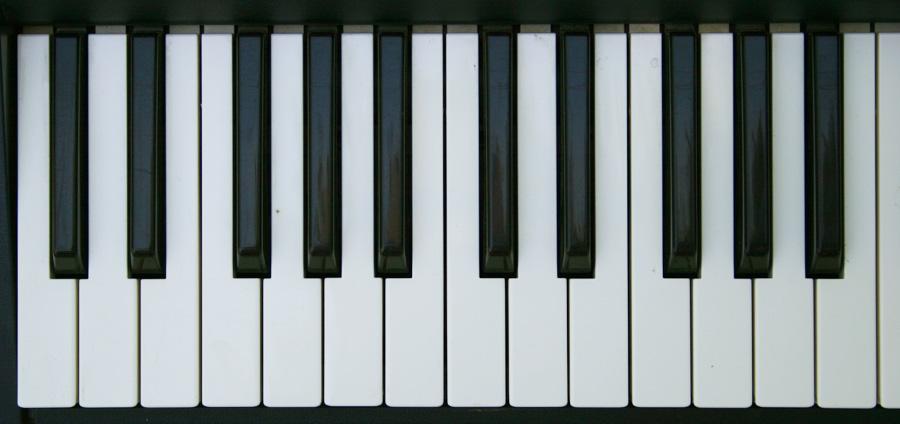
The five black keys on a piano form a pentatonic scale. They appear in repeating patterns of two and three. By starting on any one of the five black keys and playing only the black keys until reaching the same note one octave higher, you will hear one of the pentatonic modes.
Starting on a different black key produces a different mode.
The white keys between the black keys represent the skipped notes in the staircase analogy.
Pentatonic Tuning on the Native American Style Flute
The typical six hole Native American style flute is tuned to play two pentatonic scales, Mode One and Mode Four.
Understanding these pentatonic patterns helps clarify why the flute is intuitive and forgiving. Because the scale eliminates dissonant combinations, the player is free to explore without producing harsh tones.
This article is based on the work of Marcy Paulson in her article How to Understand Pentatonic Scales and is published with her approval.