
History of the Native American Flute Origins, Development, and Modern Revival
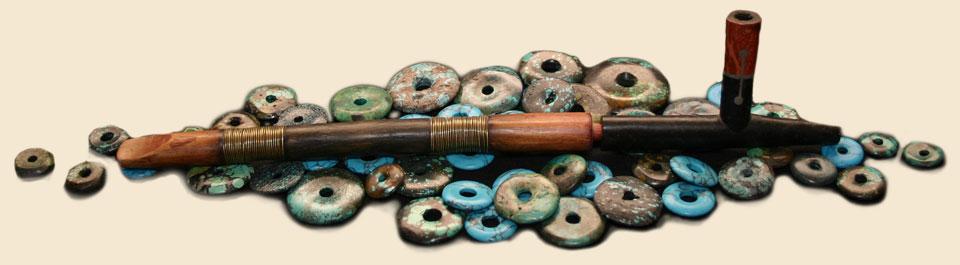
History of the Native American Flute: Early Accounts and Archeological Evidence
The written accounts of early explorers and colonizers often mention that the Native American peoples played flutes. These accounts do not, however, include pictures or descriptions of these instruments. So, it is probable that there were many different types of flutes in use. This is confirmed by archeological evidence.
The specific type of instrument we are concerned with is technically called a two chambered duct flute or dual chambered duct flute. This is the type of flute now commonly referred to as the Native American flute. This type of flute is also called a Native flute, Love flute, Indian flute, and Courting flute.
A two chambered duct flute has a slow air chamber (hallow section) at the head end of the flute into which air is blown. The air goes through a duct or channel, which conducts air from this chamber to the splitting edge where part of the air is directed down into another hollow chamber called the sound chamber or bore of the flute. A solid area separates the two chambers. This flute design is unique to the North American region of the planet.
Oral Tradition and Cultural Origins
The history of the Native American flute is not very clear. This is due to the fact that indigenous peoples of North America – who are credited with the creation of the flute – did not have written language. Consequently, there are no written records of the Native American flute in pre-Columbian times.
The Native American peoples preserved their history through stories that were passed from generation to generation. These stories – called Creation Myths or Origin Stories by anthropologists – told of how the people came to be, who they are and how they came to be where they are. The stories also gave accounts of how they acquired different aspects of their cultural heritage. In many tribes, these stories were expressed in the form of song. Some of these songs were so long and detailed that they would take days to sing. Usually, they were sung in the form of nocturnal ceremonies.
There are many stories from different tribes about how the Native American flute was discovered – created – given to the people. A common one concerns a woodpecker, a hollow branch, and the wind. These stories often revolve around a young man wanting to attract the attention of a maiden. A little searching of the web will bring up dozens of these stories.
Ceremonial and Social Use
The indigenous people of North America were divided into numerous individual tribes each having their own cultural traditions and practices. The Native American flutes construction, meaning and use varied from one group to another. The Native flute as we know it is associated with the tribes of the Great Plains and Southwestern regions. Historical examples of the Native flute are documented among the Ojibwe, Northern Shoshone, Pueblo peoples, O’odham and others.
Courtship is the Flutes Best Documented Social Use
Among the Great Plains cultures the Native American flute became so strongly associated with courtship that museums still routinely classify historical instruments as “courting flutes.” The Smithsonian, for example, has an Oglala Lakota courting flute from about 1870 that was collected at Pine Ridge. The Metropolitan Museum describes the courting flute as widespread among Northern Plains peoples and notes the tradition that a young man played it to express affection for a woman.
Ceremonial and Spiritual Use
The Hopi people of the Southwestern area of North America have had an organized group called a Flute Society. Flute Society members use the flute for ceremonial and healing purposes. We may assume the other Native tribes had similar relationships to the flute. Oral traditions usually confine the use of the flute to men. These constrictions have, however, been relaxed in modern times.
Prehistoric Origins of the Native Flute: Early Materials and Construction
The first dual chambered duct flutes were probably made of river cane (Phragmites australis), that has nodes (partitions) on the inside of a hollow tube, similar to bamboo. To make a flute, a hole was made on each side of the node with a groove or duct cut into the surface, to connect the two holes.
The duct is covered by a removable piece called the bird, fetish, saddle or block. Thereby air blown into one hallow chamber would be directed against the splitting edge of the hole in the adjacent chamber. Flutes of this type are still crafted by some Southern Arizona tribes.
In historical times the first collected examples of the Native American flute appear to date from no earlier than the nineteenth century. Dr Richard Payne, an authority on this subject, believed that what is we now call the ‘Plains style’ Native American flute – originated with the Northern Ute tribe. This flute is essentially a modification of the cane flute made using another material – a hollowed-out piece of wood.
These early Plains style flutes were made of an appropriately sized branch of a soft wood with a pithy center that could be hollowed out. They had the duct cut into the body of the flute. Examples of these flutes were collected in the 1820s. It is conjectured that the Plains flutes were a variation on the type of cane flutes found in the Southwest among the Papago and Yuman peoples.
Dr Payne believed that the knowledge of the wooden Native American flute dispersed from the Great Plains region south to the Taos Pueblo community. From there it was carried to other Southwestern tribes, then to the plains tribe of Oklahoma. Subsequently, the flute spread to other plains areas and then to Northern and Eastern tribes.
Another line of thought conjunctures that the inspiration for the design of the Native American flute came from the observation by Native peoples of the construction of church organs. It is also possible that they arose from modifying the design of European recorders. All that we can know for certain is that – baring the invention of a time machine – the complete history of the early development of the Native American flute is lost in time.
Suppression and Revival
The current renaissance and refinement of the Native American flute began in the late 1960’s when there was a Native roots revival centered on the flute. Up until that time, because of the suppression of Native cultures by the federal government and the consequent disruption of tribal societies and cultural traditions the practice of making and playing the flute had almost died out. Its preservation is attributed to Elders on rural reservations.
Native artists such as Doc Nevaquaya and Carl Running Deer, who had learned the art of making and playing flutes from their grandfathers, were important figures in the revival. Some makers such as Raven Charles King and Arnold Richardson turned to historic flutes for inspiration. The collecting and research of Dr Richard W Payne also helped reintroduce the flute to Native and non-Native people.
Standardization and Modern Tuning
Up until modern times, the dimensions of the Native American flute had been taken from the measurements of the individual player. For example, the length of the flute might be measured from elbow to wrist. The placement of tone holes was measured by the length of finger joints. As a consequence, these flutes were not tuned to any specific or standardized scale. Holes would be made and enlarged until the instrument sounded good to the maker. This type of tuning is now called Grandfather Tuning.
During the 1970s and 1980s, flute making shifted from individual players making their own flutes to craftsmen making flutes in quantities for others to play. The tuning of Native American flutes began to be brought into conformity with Western musical traditions. The mode one pentatonic scale was adopted for the tuning and playing the Native American flute. This helped further standardize the instrument. These developments combined to help make the instrument accessible to individuals from other cultures and musical traditions.
Influential Figures in the Modern Era
During the 1980s, two individuals had a significant impact on Native American flute making and playing. The first was the music of R Carlos Nakai. His popular recorded flute music mixed traditional with New Age influences and ambient sound to produce a composition that was universally appealing. His recordings and performances encouraged countless people to start playing the Native American flute. Second, was the publication of a series of books on flute design and fabrication by Lew Paxton Price.
These little books contained a wealth of information on every aspect of making a Native American flute. At the time these books were the only reference on the subject, and they helped to guide many contemporary makers through the initial stages of their flute making journey.
The Native American Flute Today
The Native American flute and flute playing has continued to improve and evolve through subsequent years. Modern electrical tools and fabrication techniques have allowed flute makers to improve precision and reduced crafting time. Flutes are being made not only of softwoods, cane, and bamboo but of exotic hardwoods, plastic, and metal. Multiple tone chamber flutes (called drone flutes) have been introduced. Flutes are now available in a range of keys spanning two octaves.
Today the Native American flute and the Native American style flute is being played in every corner of the world. I myself have sent flutes to Europe, South America, the near and far East, Asia and Australia. Flutes are used in traditional Native American ceremonies and contemporary healing modalities. Flute circles are active, growing and bring people of diverse heritage together. The flutes power of personal and interpersonal healing is amazing. I see a bright and expanding future for this simple and accessible folk instrument.
Learn how to play the Native American style flute in our beginner lesson guide.
Frequently Asked Questions About the History of the Native American Flute
When was the Native American flute first created?
The exact origin of the Native American flute is unknown. Archeological evidence and oral traditions suggest it existed long before written records in North America.
What is a dual chambered duct flute?
A dual chambered duct flute is an instrument with a slow air chamber and a sound chamber separated by a solid plug. Air is directed through a flue to create tone.
Did Native Americans use flutes for ceremonies?
Yes. Many tribes used flutes for ceremonial, healing, and social purposes. Some tribes such as the Hopi had organized flute societies.
When did the Native American flute become standardized?
Modern standardization began in the 1970s and 1980s when craftsmen adopted the Mode One minor pentatonic scale and tuned flutes to Western pitch systems.