
How Ancient Territories Flutes Are Made
Handcrafted in a Small Shop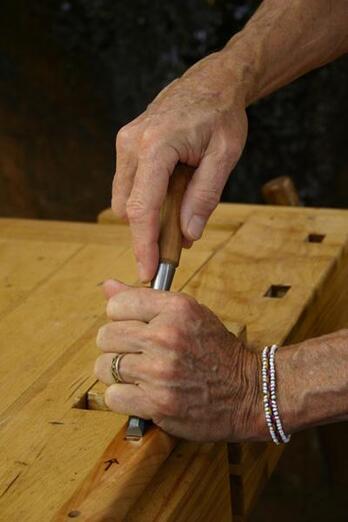
When you understand what goes into making an Ancient Territories Native American style flute you will appreciate what you are paying for.
Knowing How to Select the Best Wood is the Foundation of a Quality Native American Style Flute
I have worked with domestic and exotic hardwoods for more than thirty years. During that time I have studied under several master craftsmen. As a consequence of this experience, I have developed a keen eye for the highest quality wood. I am teaching Grayson my wood selection skills. Search, look, search again for those special precious, special boards.
During a visit to the wood dealer, we will sort through hundreds of boards by hand searching for that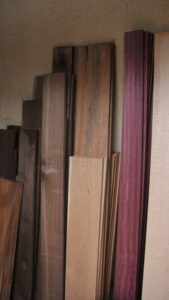 rare, exceptional wood.
We are searching for wood with special pattern, color, tight grain and density. This work is slow, heavy, and time consuming. In a single visit we may handle several thousand pounds of wood.
All the vivid colors found in our flutes are natural. We do not use stains or dyes.
Milling and Matching the Halves
1. First we first rip cut boards into long pieces each one the width of a flute. Two adjacent slices become the left and right halves. These can be book matched so the grain forms a near mirror image on the top of the flute when glued together.
2. Flaws such as knots, cracks, and blemishes are removed.
3. Then one edge of each length is trued on a machine called a jointer. The book matched halves are labeled so they remain paired.
4. The paired pieces are then crosscut to rough length based on key of the flute. Two adjacent slices become the left and right halves. These two pieces are called the flute blank. These are book matched so when glued together the resulting grain forms a near mirror image on the top of the flute.
5. The book matched halves are labeled so they remain paired.
6. The bore side of each half is flattened on the jointer, so the glue joint aligns accurately.
For how key relates to length and bore, see our Native American Style Flute Facts and Dimensions article.
Step Two Cutting the Bore and Slow Air Chamber
7. The bore and Slow Air Chamber of the flute are hollowed out on the table saw using a device called a molder head. To do this requires two passes over the cutter blades to create the half round cut in each side of the flute blanks. The large groove does not go entirely through to the mouth end.
8. The mouth hole is cut with a 3/8-inch cove bit on a device called the router table.
9. The jointed surfaces that will be glued together are lightly sanded to give the glue proper bite.
Step Three Making and Sealing the Ramp Plug
10. Plugs separating the bore from the Slow Air Chamber are cut from birch wood dowels. The Bore end of the plug is cut square. The Slow Air Chamber end is cut at a 52-degree angle to form the gentle ramp that guides air up and out of the SAC and into the flue.
11. The plugs are sanded and soaked in polyurethane so they will resist moisture absorption and swelling, which could lead to cracking.
For why the Slow Air Chamber matters, see our Importance of the Slow Air Chamber article.
Step Four Cutting the Sound Generating Mechanism
12. The SAC exit hole and the True Sound Hole are cut, with half of each hole formed in each half of the flute.
13. The Bore and Slow Air Chamber interior are hand sanded before sealing.
14. The inside surfaces of the flute are sealed with polyurethane, then sanded again by hand to remove raised grain and leave a smooth interior surface.
Step Five Gluing the Flute Together
15. Glue is applied to both halves and the plug, spread into an even film with a finger, and the plug is positioned inside the flute. The halves are aligned so the SAC exit and True Sound Hole match, then the flute is pressed tightly along its length to ensure a clean, strong glue joint.
16. Squeezed out glue is cleaned from the bore and SAC with a cotton swab before it dries.
17. After curing, excess glue is scraped from the outside of the flute.
18. The top and bottom surfaces are cleaned up on a tool called a belt sander.
19. The top and bottom of the flute are run across the jointer to flatten and square the flute.
Step Six Cutting the Flue and Voicing the First Sound
20. The flue is now rough cut into the body of the flute between the Slow Air Chamber and the bore using a handheld router and jig.
21. Any misalignment between the two halves is corrected with hand files and chisels around the SAC exit and True Sound Hole. This work is exacting because errors affect the sound generating mechanism.
At this point a bird can be placed on the nest and the flute can speak for the first time.
If shape and color were all that mattered, flutes would be what is known as wall hangers. A wall hanger is a flute that looks great but doesn’t have a good sound. This a musical instrument and the most important thing is sound quality. Our sound generating design places the air focusing channel in the flute body rather than in bottom of the bird. This approach is sometimes called the Eastern woodlands style and it allows more consistent focusing of the air stream, a cleaner sound, and greater volume without breaking octave.
Shaping the Flute Body
At this stage the flute is still a long square block with a hollow center and strange openings on top. Now it must be shaped into that distinctive Ancient Territories form.
Our flutes are not round like most Native American style flutes. Round flutes are usually turned on a lathe. Lathe turning is fast and can be done with a machine. Grayson and I prefer a form that feels like a sculpted object rather than a tube.
Ancient Territories flutes have a softly rounded triangular cross section, subtle angles, and asymmetrical curves. The shape, which has a sculptural quality, is designed to please the eye and also feel comfortable in the hands and against the lips.
Rough Shaping and Refinement
22. The mouth end is trimmed to final length with a crosscut on the chop saw.
23. Excess wood at the mouth end is removed with angled table saw cuts.
24. The bottom sides are rough milled using a custom router bit, beginning the triangular form.
25. The top surface is curved with a special router bit.
26. The angular surfaces around the mouth end are softened with a 3/8-inch round over bit. Hand shaping begins on a belt sander with coarse grit to refine angles and surfaces. Sanding progresses to finer grit to smooth and refine the form.
27. A handheld rotary tool is used to clean the inside edge of the mouth hole.
28. A flap sander softens remaining sharp edges.
29. Finer grit is used to refine surface quality further.
The head end is shaped so the flute can be held against the lips rather than placed in the mouth. The top surface is slightly flattened for comfortable finger placement.
Tuning and Tone Hole Work
30. The barrel end is trimmed on the chop saw to tune the fundamental note. The longer the barrel, the lower the key. This is done in small steps, testing on an electronic tuner and making fine adjustments as needed.
31. Tone holes are drilled on a drill press with a laser sight using a machinist vise for precise alignment and spacing.
32. The inside of the bore is sanded with a special tool to remove hanging fibers left by drilling the tone holes.
33. The outside edges of tone holes are slightly rounded for comfort.
34. The inside edges of tone holes are rounded, then each note is tuned by shaving small amounts of wood from the bottom of the tone holes to bring notes into balance.
35. The inside edge of the end of the barrel of the flute is softened with a rotary cutter.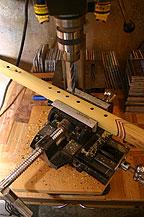
36. The outside of the flute foot is shaped and rounded over for appearance and comfort.
37. The end of the flute is further refined with sanding.
38. Exterior surfaces are smoothed again, taking care not to touch the True Sound Hole edges.
For a technical overview of how these dimensions interact with tone, see our Factors Affecting Tonal Quality article.
Making the Sound Wave Bird
39. The flute body is ready for finishing, but the birds must be made
40. Bird stock is ripped to dimension on the table saw.
41. Pieces are then resawn into thin slices on the band saw.
42. Surfaces are smoothed on a thickness sander.
43. Three strips are glued into a laminated bird blank and clamped.
44. Excess glue is removed and the bottom surface of the blank is squared on the jointer.
45. The blank is trimmed to final height on the table saw.
46. The blank is crosscut into smaller pieces to make the individual birds.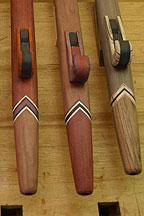
47. A hole is drilled to form the internal wave curve.
48. The chimney is routed out. When the bird sits on the flute, the chimney surrounds the True Sound Hole on three sides. This helps focus the air stream and protect it from cross currents.
49. Band saw cuts form the wave opening.
50. Waste is removed and trim cuts rough the outline of the bird.
51. The bird form is rounded and refined on the belt sander.
52. The inside curve is smoothed on an oscillating spindle sander.
53. Edges are softened with a round over bit on the router table.
54. The bottom surface is flattened and smoothed.
55. The top surfaces are softened and rounded.
Finishing and Sealing
We finish both flute and bird with polyurethane varnish. When dry, polyurethane is non toxic.
We use polyurethane because it offers durability and flexibility. Unlike harder finishes such as some epoxy and lacquer surfaces, it resists chipping and cracking. It is waterproof and impervious to alcohol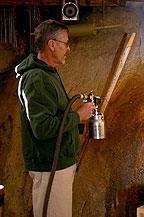 and saliva.
Polyurethane is also resistant to moisture transfer. This matters because moisture absorption can lead to expansion and contraction and possible cracking. It also filters ultraviolet light, helping preserve natural wood color.
We have experimented with natural finishes such as tung oil and other oils. They do not hold up as well in daily use. In addition, Slow Air Chambers finished only with natural oils can absorb moisture, grow mold, and develop an unpleasant odor.
Exterior Finish
56. The raw flute is cleaned of dust and a light coat of polyurethane is sprayed with an HVLP sprayer, then allowed to dry for 24 hours.
57. The surface is lightly sanded with fine paper to smooth raised grain and provide tooth for the next coat.
58. Areas not reachable by machine are hand sanded.
Slow Air Chamber Sealing
59. Two stage epoxy is applied to the interior surfaces of the Slow Air Chamber by pouring through the SAC exit hole and rotating the flute to coat all interior surfaces. Excess epoxy drains out with the flute suspended mouth end down. This ensures complete sealing even along glue joints.
Final Refinement and Second Tuning
60. Interior surfaces of the SAC exit and True Sound Hole are further refined with hand tools.
61. A second coat of polyurethane is sprayed on the exterior. The bird is finished in the same manner.
62. Because finish can slightly change critical dimensions, the flute is tuned again.
63. The finish is hand sanded and polished to a satin like feel.
64. A leather thong is cut to secure the bird, and the flute is assembled.
For more about finishes and why we use them, see our What Is a Finish article.
Sound Quality Comes First
If you have followed these steps, you can see the attention to detail that goes into our Native American style flutes. We strive to make a musical instrument that will be played, not just admired.
A well made flute becomes a companion for years; perhaps a lifetime.
Frequently Asked Questions About How Our Flutes Are Made
Why use book matched wood halves
Cutting adjacent slices allows the grain to mirror across the top of the flute, creating natural symmetry without stains or dyes.
Why seal the Slow Air Chamber with epoxy
The SAC is exposed to moisture from breath. Sealing helps prevent moisture absorption that can lead to swelling, cracking, mold, or odor.
Why cut the flue into the body instead of the bird
A body cut flue allows more consistent focusing of the air stream against the splitting edge, supporting clarity and stable volume
Does finish affect tuning
Yes. Finish can slightly change critical dimensions and airflow behavior, so tuning is checked again after finishing. A hard finish especially on the interior surfaces makes for a crisper tonal quality.