
Your shopping cart is empty!
About John
I have always liked working with wood
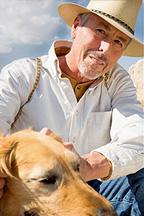
My boyhood was spent under the tree canopy of the mixed deciduous forest of the Eastern seaboard. White oak trees 100 feet tall. Maple, birch, beech, cherry, hickory, elm, all around and overhead, trees. Their roots growing deep down into the earth. I climbed in and played under trees. As a small boy I was always carving and making things out of wood.
I grew up among men who knew the uses of each different species of tree and how to use different parts of the tree for different purposes. They had a respect and love for trees. This love and respect was imparted to me. I learned to appreciate wood as a living thing, a sacred thing, something that was an important part of a person’s life.
The first time I got serious about working with wood was at a boatyard in California. I was living on an old wooden schooner that had been built back in the 1930’s. It had a mahogany hull 2 inches thick, white oak frames, a teak deck and pine masts. The boatyard did repair on wooden fishing boats which were still common at that time. Because my boat was moored right next to the boatyard I got to know the night watchman. When everything closed down and the workers went home, he let me go into the big shop and work on repairs for my own boat. During the day I hung around and watched, listened and learned from craftsmen who had spent their entire lives working with wood.
I’ve been making my living working with wood ever since
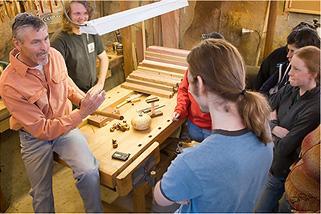 I ended up owning a shop that made custom furniture for interior designers. At its peak there were 18 craftsmen churning out entertainment systems and custom furniture. Instead of being out in the shop working with wood I was in an office. I didn’t like it, so I finally got out. Now I’m back in a small shop with a few fine tools. I’m doing what I love best, making beautiful things out of wood.
I discovered the Native American style flute twenty five years ago. My first Native American style flute was made out of a river reed. It didn’t sound very good but for the first time I started to enjoy making music. My fingers enjoyed dancing on the holes and every day I got better. Soon I was looking for a better Love flute, and then another after that. Finally Spirit led me to Clint Carlyle, the man who would become my teacher.
My first few flutes were tentative affairs made with rather primitive tools. Then I invested in some better tools. With each new Native American style flute my understanding of flute dynamics improved. The sound became true and clear. I know that I am not at the end of this road and probably never will be. I’m grateful for that because part of my joy comes from listening for the lessons that each new flute has to teach.
My backyard shop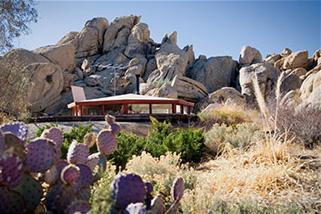
This is the place where Spirit Takes Form. I designed and built the shop myself. It is mostly below ground level with the windows and roof above the ground. The shop is quite small but adequate for Grayson and myself.
About Grayson
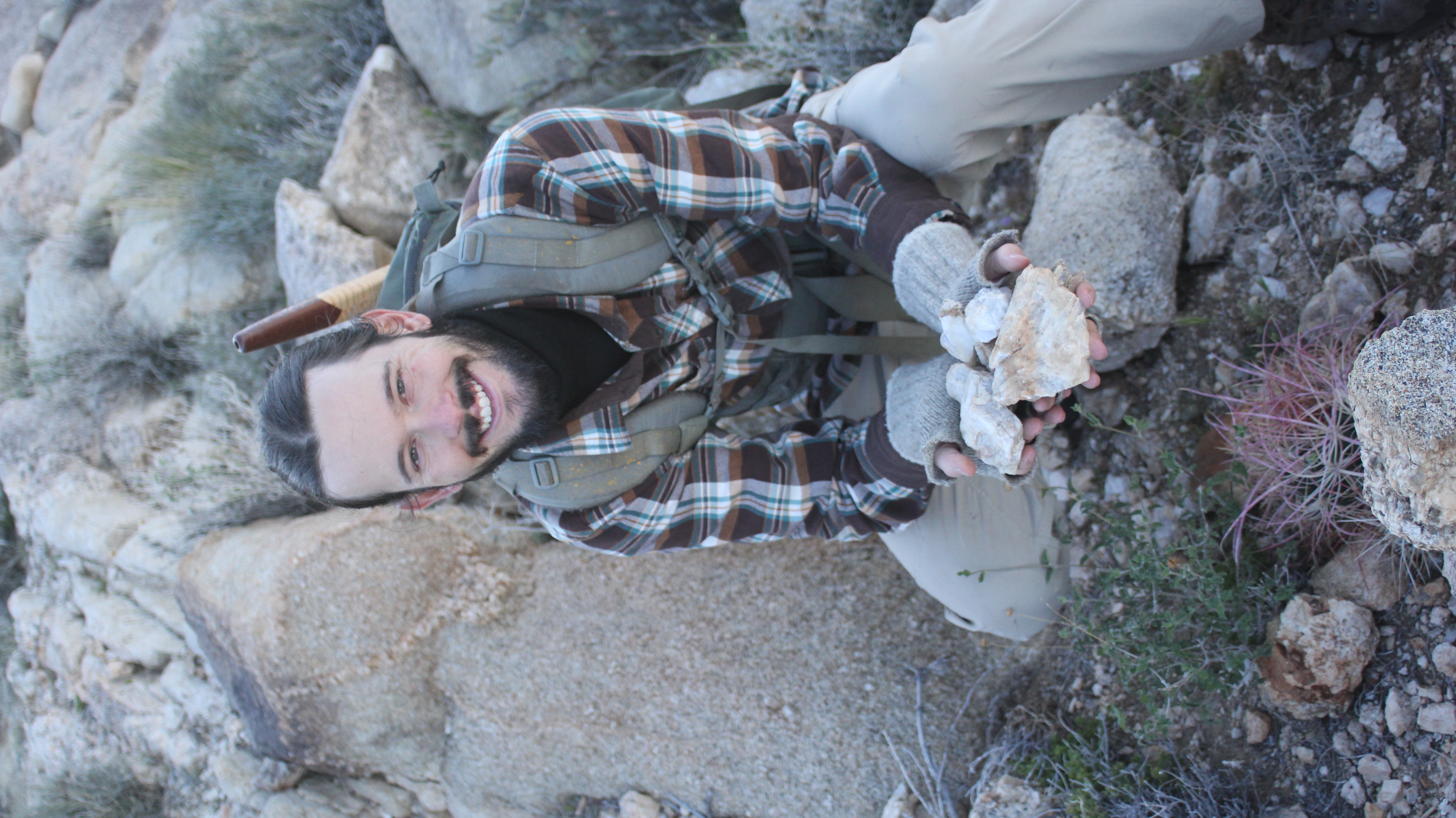
How I arrived here
Hello, my name is Grayson Henshaw. You may be wondering how I arrived here, as a Native American style Flute player and maker. Truth is, I’m still wondering myself. It seems that my being here is the result of a journey I never planned, but somehow always felt guided toward. The quiet work of higher guidance. Something unseen yet deeply felt. This is the driving force that keeps me in the shop, hand-crafting Native American style flutes for you.
Where it started
Ever since I heard the Native American flute for the first time, it sparked something deep within my spirit. The flute became a tool or a bridge that allowed an awakening of a connection that already existed within me and to nature. Since this time, I knew I wanted to either help people or help Mother Earth. And since I have always been rather introverted and an outdoorsman, I decided to embark on a path in natural resource conservation.
While attending my college studies at the University of Montana, I immersed myself more in the Native flute and American Indian culture. I was never musically talented and to be quite honest, music intimidated me because of its structured nature. Despite this, I felt a call that could not be ignored. I bought my first Native American style flute in the spring of 2019. The pure joy and excitement I had, holding that flute for the first time, is a memory that has not faded. Finally, an instrument that I could play and make wonderful sounding music with.
My first flute was a High Spirits Crow Flute in the key of “A” made with ebonized walnut and turquoise inlay. It was a good beginner’s flute to get me started on a path that would eventually lead me to making my own Native American style flute.In nature with my flute is where I healed, learned and grew. It’s where my raw authentic self could come forward and express those feelings and emotions within. I had only myself, and the nature that surrounded me was my audience.
After graduating college in 2021, I went to work several jobs in both private and public sectors. Then, in summer of 2024, I had the amazing opportunity to become a traveling forester working across the United States collecting forest inventories. I set out on the road with my newly bought camper trailer and minimal belongings.
I traveled down into the southwest then spent winter in the east and by springtime I was ready to return to the mountains of the west. Through a period of harship, I noticed myself returning to the Native flute whenever I would experience emotions of sadness or anger. To this day, I am still baffled by how much healing I gained by playing my flutes.
An Important awareness
What I’ve come to understand is that the Native American style flute is more than an instrument. It’s a release, a companion, and a conduit. The flute becomes a pathway through which emotion can flow and be released, instead of being held inside. Its sound carries emotion in a way that words often can’t. Every breath becomes presence, and every note becomes a prayer. Not just to be heard, but to be felt. Somehow, the flute gives permission for feelings to surface gently, without judgement. Anger softens, grief loosens, and confusion begins to settle into clarity. It’s as if the music gives shape to the things I cannot explain, and in doing so, it transforms them. The resonance of the flute doesn’t just fill a room; it feels the heart. Through its voice, I’ve discovered not only healing, but a deeper connection to spirit, to the earth, and to a stillness within myself that I never knew existed.
How I Met John 
After extensive research, I found someone who I was familiar with from a search many years ago; John at Ancient Territories. I drove five hours south down into Yucca Valley in the search for handmade Native American style flutes that would allow my music jounrey to progress. This opportunity to visit a flute maker and play the different flutes that were available in person was an experience I could never forget. I knew, right away, John was a man of kindness, compassion and humility. We talked for a couple hours on the deeper workings of life, and I played some flutes.
The words i'll use next to describe my feelings of playing one of John's flutes for the first time comes with complete sincerity. Before I blew my first breath, I knew by touch how special this instrument was. I felt its story; the way it was shaped, finished, and cared for carried meaning. John didn’t just build a flute, he transformed it. In a way, he alchemized it, turning wood into something with spirit, voice, and purpose. I could tell it wasn’t rushed or mass-produced; it was crafted with patience, passion, and respect. There was love in the wood, not just craftsmanship. And at that moment, I understood that a flute like this isn’t made by hands alone. It’s made through years of learning, through quiet dedication, and through a genuine desire to share something meaningful with others. This was the flute I was searching for.
Later that evening, I heard a voice from within. It was something I would have never had the courage to say out loud, yet the calling felt undeniable. Before leaving John’s house, I finally spoke it. I told him that I wanted to learn to make a flute for myself and asked if he might be willing to guide me if I returned. In truth, the question was my way of easing into something much bigger; a way to test the waters without admitting what my heart already knew- I wanted to learn how to make flutes, not just one.
John didn’t hesitate. He smiled, saw straight through the hesitation and the polite phrasing, and said “so… you want to make flutes?” It seems that John understood. Not just the request, but the calling behind it. And as it turns out, he had been hoping to pass down what he’d learned over his years of dedication to the craft. The timing, the place, and the connection between us felt too aligned to be coincidence. Looking back, it’s clear that it was all divinely arranged.
Master & Apprentice
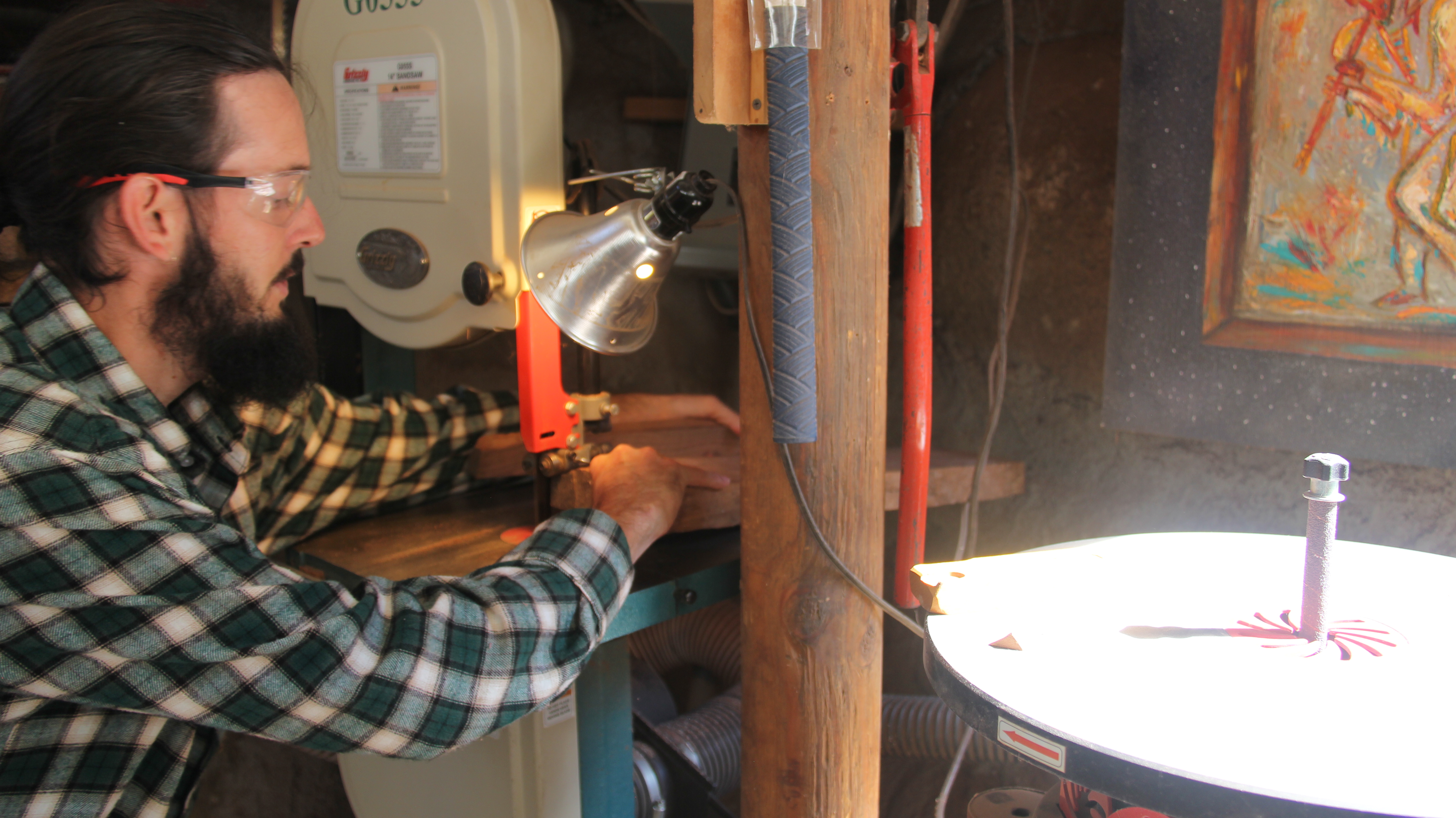
From the very beginning, when human hands first began shaping wood and stone, there has been the tender path (sometimes, not so tender) of master and apprentice. Not in loud places, but in quiet workshops, where the scent of fresh shavings fills the air and light settles softly across a worn workbench. In ancient Egypt and Babylon, this bond was honored and protected. The old laws of Hammurabi even spoke of it, that a craftsman must pass his knowledge to the next pair of willing hands. Not only how to carve or shape, but how to listen. How to be patient. How to care for the work as something alive. It is a gentle passing of a flame, from one heart, to another.
John is not only my master teacher, he is my mentor, and most importantly, he is my dear friend.
For over twenty five years, he has walked the path of flute making. And in the old fashioned way, the true way, he is passing that knowledge down to me. Now, in the ancient days, an apprentice might have learned by getting a sharp knock on the head with a stick for every mistake. I am grateful to say that is not our method. Though, if it were, I might have a few more bumps by now, because I have made my share of mistakes. Maybe more than my share. All part of the learning. Instead of a stick, John offers patience. Instead of harsh words, steady guidance. He lets me stumble, lets me sand too much, cut too deep, mismeasure, and then gently helps me see it clearly. And somehow, through all those small blunders and lessons, the craft begins to settle into my hands.
We work side by side with the all-pervading, nameless energy that moves through all things. Some call it God. Some call it Source. Some call it Creator. For us, we simply call it Spirit.
Our relationship, at its core, revolves around listening to Spirit.
The greatest lesson John continues to teach me is this. Let go of what you cannot control and let Spirit take the wheel. In every decision we make. In every flute we shape from raw wood. In every quiet conversation between us, and every word we share with others, we try to remember that.
In many ways, we see ourselves as humble servants employed by Spirit, entrusted with the simple and beautiful task of spreading love, beauty, and joy through music and craftsmanship.
We truly love the work we do, that love carries into every flute we create for you.
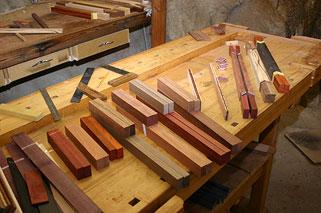
I don't chop a flute out of a tree branch with a hatchet. I use a full complement of modern wood working tools.