
Native American Style Flute Anatomy
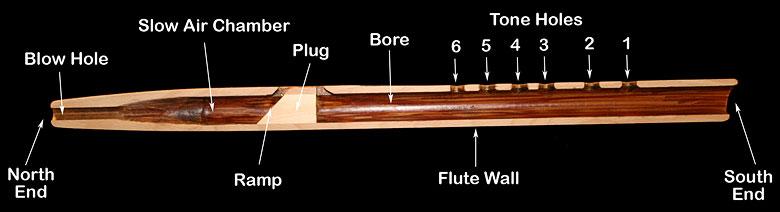
The Native American style flute is technically called a ‘dual chambered duct flute’. The flute has two separate hollow chambers separated by an area of solid wood. The chamber closest to the mouth end of the flute is called the slow air chamber. The chamber that terminates on the lower end of the flute is called the barrel or sound chamber of the flute. This dual chamber configuration is one of the defining characteristics of the Native American style flute.
Historical Origin of the Dual Chamber Design
The two-chamber configuration is generally believed to derive from early flutes made from river cane by Southern Arizona tribes.
River cane, like bamboo, is divided by natural nodes. These natural partitions created separate chambers. By cutting openings between adjacent sections, early flute makers directed air from one chamber into the next.
The modern Native American style flute preserves this principle in hardwood form.
Why It Is Called the Slow Air Chamber
‘Slow air chamber’ is a sort of misnomer. This chamber got its name from the fact that air moving through this part of the flute is moving slowly in comparison to the air going through the duct of the flute. The air when it funnels into and moves through the constricted duct of the flute it is going quite fast. It is curious to note that the air moving through the barrel of the flute is moving at a much slower speed than the air in the so called slow air chamber.
The name refers only to relative airflow speed compared to the duct.
The Slow Air Chamber as an Airflow Conditioner
It is commonly assumed that the slow air chamber is not a very important part of the Native American flute. It’s just sort of there containing the air before the real work of sound generation begins. In my experience this is definitely not the case
One of the primary characteristics of the tonal quality of a well-constructed Indian flute is its purity. This is in part due to the nature of the stream of air that is striking the splitting edge. When air leaves the mouth and is blown into the mouth hole of the flute it contains turbulence. As it moves through the Slow Air Chamber, much of this turbulence is dampened. The chamber allows chaotic airflow to settle before it enters the flue The stream of air going through the duct is smooth with little turbulence in it. The air is behaving in this manner because in its journey through the slow air chamber the initial turbulence that is present when it leaves the players mouth and enters the SAC has been largely eliminated. So the SAC acts as a damper of sorts to calm turbulent air.
So a direct, smooth, unimpeded path for the air to follow through the SAC and into the flue is important for a clean, sweet sound. That is why a long, gentle ramp out of the SAC is very important For a clean, sweet tone, the air must follow a smooth and direct path from:
- Mouth
- Into the Slow Air Chamber
- Across the ramp
- Through the flue
- Against the splitting edge
A long, gentle ramp leading from the chamber into the flue further reduces turbulence and improves clarity.
For more on how this affects tone, see our Factors Affecting Tonal Quality article.
The Slow Air Chamber as a Resonance Chamber
The Slow Air Chamber also acts as a secondary resonance chamber. A resonance chamber is a partially enclosed space the forces the resonating sound vibrations to bounce back and forth off the wall of the chamber before exiting the chamber space.
For this to function effectively:
- The chamber walls should be smooth
- The surface should be sealed and hard
- The slow air chamber volume should be as large as possible for maximum effect.
The bore of the flute, where sound generation takes place. is also a resonance chamber. It is not, as some assume, a resonator like the body of an acoustic guitar.
Material and Surface Considerations
Hardwood resonance chambers tend to reflect sound energy more effectively than softer materials. Historically, speaker cabinets were constructed from dense plywood for this reason. The goal was to prevent absorption of vibration and thus preserve clarity. Similarly, in flute construction, smooth sealed interior surfaces improve resonance stability and tonal focus.
For deeper technical details on bore dimensions and sealing, see our Native American Style Flute Facts and Dimensions article.
Frequently Asked Questions About the Slow Air Chamber
What does the Slow Air Chamber actually do
It stabilizes turbulent air before it enters the flue and contributes to resonance balance within the instrument.
Does the size of the chamber affect tone
Yes. Chamber volume and surface smoothness influence airflow behavior and tonal purity.
Is the Slow Air Chamber unique to Native American style flutes
Yes. The dual chamber design distinguishes it from most other duct flutes.
Does wood choice affect the Slow Air Chamber
Hardwood surfaces tend to reflect vibration more effectively, contributing to clarity and stability.